PCI Protocol and Device Driver Development. (P018)
Abstract
Peripheral Component Interconnect(PCI)
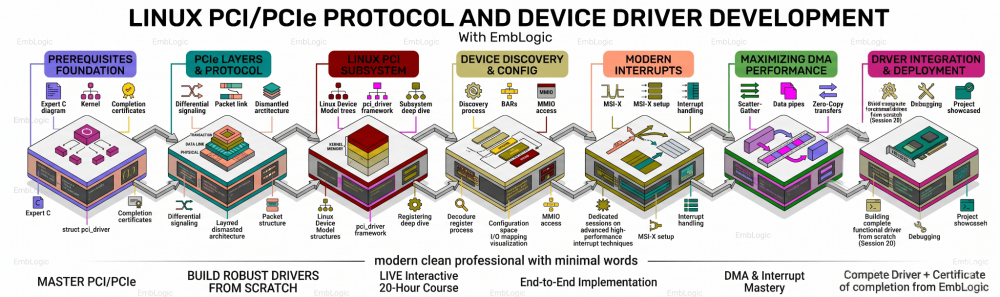
The Peripheral Component Interconnect (PCI) and its modern serial successor, PCI Express (PCIe), are essential standards for connecting high-speed peripherals like graphics cards, storage, and network adapters to a host system. Moving beyond the legacy shared parallel bus, PCIe utilizes a scalable, layered, point-to-point architecture based on differential signaling lanes. The protocol governs crucial system interactions, defining the Configuration Space for device discovery and resource allocation (BARs), Memory-Mapped I/O (MMIO) for register access, and efficient interrupt mechanisms (MSI/MSI-X). Mastery of the PCIe layers is critical for developing robust Linux device drivers that enable the operating system to utilize the device's high-bandwidth capabilities.
Welcome to the Linux PCI Protocol and Device Driver Development Course!
Peripheral Component Interconnect Express (PCIe) is the high-speed backbone of modern computing, facilitating essential communication between the CPU and all critical peripherals, from graphics cards to network adapters. This intensive, 20-hour live online course is designed for kernel enthusiasts and experienced C programmers ready to master this vital interface.
We will systematically dismantle the PCIe protocol's layered architecture, moving from theoretical concepts to practical kernel implementation. By the end of this training, you will have developed a complete, end-to-end Linux PCI device driver, covering crucial low-level tasks such as device discovery, handling interrupts (MSI/MSI-X), and optimizing data transfer using Direct Memory Access (DMA). Prepare to unlock the full performance of hardware within the Linux ecosystem.
Training Objective
This course is designed to provide a comprehensive understanding of the PCI/PCI Express (PCIe) protocol and the practical skills necessary to develop a fully functional Linux PCI/PCIe device driver from scratch.
Upon completion of this course, participants will be able to:
→Comprehend the architecture, layers, and transaction protocol of PCI/PCIe.→Master the Linux Device Model and the PCI Subsystem.→Develop, compile, load, and debug Linux Kernel Modules.→Access and configure a PCI device's Configuration Space and BARs (Base Address Registers).→Implement various I/O access methods: Memory-Mapped I/O (MMIO) and Port I/O.→Handle interrupts for PCI devices, including MSI/MSI-X.→Implement DMA (Direct Memory Access) for high-performance data transfers.→Develop a complete, end-to-end Linux PCI device driver from initialization to uninstallation.
Pre-requisites
This is an advanced-level course. Participants must possess a strong foundational understanding and hands-on experience in the following areas:
1. Essential Programming Skills→Expert C Programming and data sructures→Basic Toolchain Proficiency:→Familiarity with the GNU Compiler Collection (GCC).→Experience with make and writing simple Makefiles.2. Core Linux Knowledge→Linux Command Line Proficiency→Solid Operating System Concepts:3. Hardware and Architecture Understanding→Computer Architecture Basics:→Grasp of Memory Addressing and the concept of I/O and Memory-Mapped I/O (MMIO).→Understanding of Interrupts and the general flow of a device request.4. Linux Device Driver Background (Highly Recommended)→The aspirants must have already completed these modules...→Development Environment:→Ability to set up a Linux machine (physical or virtual) for kernel development, including installing kernel headers and source code.
Agenda
→The Duration of Training is:→20 Live online sessions followed by assignments→Considering 4 0r 5 sessions and assignments per week,→it will take 4 or 5 weeks to understand and implement complete PCI driver.
Course Delivery
Online: Live interactive sessions via video conferencing platforms for theoretical lessons.
In-person: Hands-on labs and debugging sessions for practical, real-world application.
Hybrid: A combination of online theory classes and in-person or virtual lab sessions for comprehensive learning.
Training Methodology
Lectures: Presentations covering both foundational concepts and advanced topics in device driver development.
Hands-On Labs: Real-world programming exercises to develop and test device drivers on Linux.
Reading Assignments: Curated resources, including kernel documentation, programming books, and articles.
Videos: Visual content to supplement learning and demonstrate coding techniques and solutions.
Deliverables
→Upon completion of the course, participants will have:→A strong foundation in Systems, C programming tailored to Linux kernel and device driver development.
→Comprehensive knowledge of Linux based...→PCI protocol,→PCI device driver,→including how to develop, test, and debug drivers.→A completely implemented PCI device Driver.
→A project showcasing their ability to create a real-world Linux-based PCI device driver.→Upon Completion of this training module,,, EmbLogic will issue certificate of completion.
Salient Features of this training
→End-to-End Driver Implementation: The course culminates in building a complete, fully functional Linux PCI device driver from scratch (Session 20), integrating all learned concepts.→Dual Focus (Protocol & Code): Comprehensive coverage of both the PCI/PCIe Protocol Architecture (Physical, Data Link, Transaction Layers) and the practical Linux pci_driver framework.→Advanced Interrupt Mastery: Dedicated sessions on implementing and utilizing modern, high-performance interrupt handling techniques, specifically Message Signaled Interrupts (MSI and MSI-X).→High-Speed DMA Training: Detailed instruction and practical implementation of Direct Memory Access (DMA) for maximizing data throughput and minimizing CPU load.→Kernel Level Expertise: Deep dive into the Linux kernel's PCI Subsystem, Device Model, and MMIO/Port I/O access APIs, providing true low-level programming skills.→Configuration Space Mastery: Practical understanding of accessing, decoding, and mapping a PCI device's resources via the Base Address Registers (BARs) and Configuration Space.→Structured 20-Hour Program: A systematic 5-week structure ensures that foundational kernel concepts are established before progressing to complex PCI-specific topics.→Expert-Level Prerequisites: The course is designed for serious learners, requiring a strong background in C programming and Linux Character Device Drivers, ensuring a high technical level among participants.→Live, Interactive Learning: Delivered over 20 live, 1-hour online sessions, facilitating real-time interaction, Q&A, and debugging support.→Concurrency and Synchronization: Coverage of essential kernel programming techniques like Spinlocks and Mutexes to handle concurrency and race conditions in a kernel environment.
Training / Course Structure. click here...
After The Training is over, the trainee will be able to do. click here...
Future Prospects and Real World usage. click here...
Training Resources. click here...
EmbLogic™ is an ISO 9001:2008(QMS) (Quality Management System) Certified Company.