
Do you know how memory is allocated for structure members in C
Always, contiguous(adjacent) memory locations are used to store structure members in memory. Consider below example to understand how memory is allocated for structures.
Example program for memory allocation in C structure
|
#include <stdio.h>
#include <string.h>
struct student
{
int id1;
int id2;
char a;
char b;
float percentage;
};
int main()
{
int i;
struct student record1 = {1, 2, ‘A’, ‘B’, 90.5};
printf(“size of structure in bytes : %d\n”,
sizeof(record1));
printf(“\nAddress of id1 = %u”, &record1.id1 );
printf(“\nAddress of id2 = %u”, &record1.id2 );
printf(“\nAddress of a = %u”, &record1.a );
printf(“\nAddress of b = %u”, &record1.b );
printf(“\nAddress of percentage = %u”,&record1.percentage);
return 0;
}
|
Output:
| size of structure in bytes : 16Address of id1 = 675376768 Address of id2 = 675376772 Address of a = 675376776 Address of b = 675376777 Address of percentage = 675376780 |
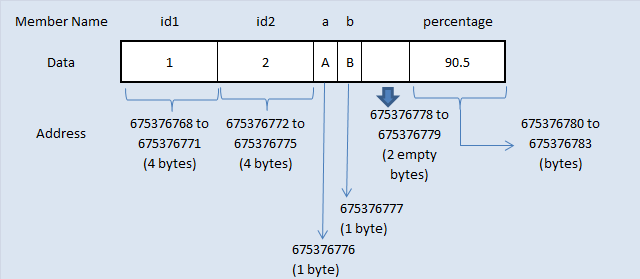
There are 5 members declared for structure in above program. In 32 bit compiler, 4 bytes of memory is occupied by int datatype. 1 byte of memory is occupied by char datatype and 4 bytes of memory is occupied by float datatype.
Please refer below table to know from where to where memory is allocated for each datatype in contiguous (adjacent) location in memory.
| Datatype | Memory allocation in C (32 bit compiler) | ||
| From Address | To Address | Total bytes | |
| int id1 | 675376768 | 675376771 | 4 |
| int id2 | 675376772 | 675376775 | 4 |
| char a | 675376776 | 1 | |
| char b | 675376777 | 1 | |
| Addresses 675376778 and 675376779 are left empty (Do you know why? Please see Structure padding topic below) |
2 | ||
| float percentage | 675376780 | 675376783 | 4 |
The pictorial representation of above structure memory allocation is given below. This diagram will help you to understand the memory allocation concept in C very easily.