Linux Systems, Devices Design, Development, Debugging.(L3)
Linux Systems, Devices Design, Development, Debugging
Introduction
Linux Systems Devices Design, Development, Debugging(LSDDDD), Is a Career Oriented Training Program supports trainees' career trajectories, from their initial job placements to reaching pinnacle positions within their fields. It encompasses the comprehensive mechanisms the program employs to facilitate this journey, including personalized mentorship, hands-on project experience, and access to a vibrant community of successful engineers.
LSDDD for Aspiring Engineers highlights the critical juncture at which the engineering sector finds itself today. Rapidly evolving technologies and an increasingly complex global economy demand a new breed of engineers. Traditional academic pathways alone are no longer sufficient to prepare these aspiring professionals for the challenges and opportunities of the 21st century. The introduction could then present the concept of a comprehensive, decade-long training program designed specifically to bridge this gap. Through a combination of mentorship, hands-on project implementation, and a curriculum that evolves with technological advances, this program aims to equip engineers not just with theoretical knowledge, but with practical skills and experiences that align closely with industry needs. Examples could include emerging fields like Embedded Systems, artificial intelligence, renewable energy, and bioengineering, where the pace of change is particularly rapid, underscoring the value of such forward-thinking training approaches.
Training Objective:
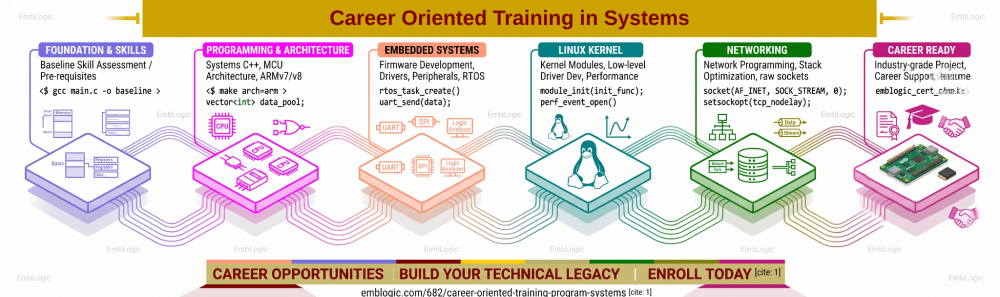
The core objective of the Systems Career Oriented Training Program at EmbLogic is to bridge the gap between academic education and industry standards for engineers and technical professionals. The program aims to instill advanced, practical skills across core competencies—including Embedded Systems, Linux System Administration, Network Programming, and Device Drivers. By leveraging a comprehensive, project-driven methodology that combines classroom instruction with extensive hands-on lab work, the training empowers participants to master device architecture, optimize real-world problem-solving capabilities, and secure a distinct competitive edge to accelerate their professional technology careers.

Salient Features of The Training Program... click here...
Pre Requisite:
→An Engineering Degree. completed or persuing in any stream,→BCA, BSc, Master of Application→A prior knowledge of a basic Computing, Electronics, any microprocessor or microcontroller should help.→General understanding about operating system concepts is assumed.
| Agenda for the training program... | click here... |
The Duration of Training would be:→The duration of training would be 600 Hours→There would be→600 Live Online Classroom Sessions of 1 Hours each.→Additional Lab Sessions as and when required.
The Training Program (course)
25 Modules and 20 Projects |
|||
|
S No. |
Code |
Module / Project Name |
Sessions |
|
1
|
000 |
10
|
|
|
2 |
001
|
50 |
|
|
3
|
011 |
10
|
|
|
4
|
002 |
25
|
|
|
5
|
003 |
30
|
|
|
6
|
006 |
Project Evolution with GitLab Code Collaborate Create. click... |
10
|
|
7
|
014 |
20
|
|
|
8
|
004 |
20
|
|
|
9
|
005 |
50
|
|
|
10
|
009 |
20
|
|
|
11
|
111 |
15
|
|
|
12
|
405 |
Advanced Character Device Driver Development and Debugging. click... |
30
|
|
13
|
205 |
Serial Port-UART Device Driver Development with Project. click... |
20 |
|
14
|
109
|
Embedded Linux on ARM, Configuring GUI and Calibrating TouchScreen, Project. click... |
10
|
|
15 |
101 |
50
|
|
|
16
|
303
|
50
|
|
|
17
|
104
|
Linux Network Programming. Implementing TCP Stack, Project. click... |
15
|
|
18
|
305
|
Linux GPIO Peripheral Device Drivers Development, Project. click... |
20
|
|
19
|
007
|
15
|
|
|
20
|
008
|
25 | |
|
21
|
025
|
Rust Programming for Embedded and AI with Project. click... |
30
|
|
22
|
019
|
Linux Platform Device Drivers Development, Project. click... |
15
|
|
23
|
016
|
20
|
|
|
24
|
209
|
Embedded Linux with ARM using TFTP Server, Project. click... |
15
|
|
25
|
309
|
15
|
|
|
Total Sessions
|
600
|
||
Deliverables:
EmbLogicTM would
provide assistance in preparing resume.
issue The Certificate of Completion for the training as mentioned above.
| Projects Portfolio for the training program... | click here... |
| Career Pathways & Placement Support... | click here... |
The Need for Specialized Training. click here...
In today's rapidly evolving technological landscape, the need for specialized training in engineering cannot be overstated. Traditional engineering education provides a solid theoretical foundation, but often falls short in equipping students with the practical skills and cutting-edge knowledge required in the workforce. As industries continue to advance, particularly in sectors like embedded, electro-mechanical devices, artificial intelligence, renewable energy, and cyber-physical systems, the gap between academic preparation and industry requirements widens. This mismatch not only hampers the employability of graduates but also slows innovation and growth within sectors critical to global challenges, such as climate change and sustainable development.
Specialized training programs, designed with a keen eye on the future, aim to bridge this gap by offering curriculum that is both dynamic and directly aligned with industry needs. For example, a program focusing on renewable energy engineering might include hands-on projects with solar and wind power, along with mentorship from professionals actively working in sustainability roles. Similarly, a course on artificial intelligence could provide practical experience in machine learning algorithms and their applications, preparing students for immediate contributions in tech-driven roles. These specialized programs ensure that aspiring engineers are not just theoretically knowledgeable but are also adept at applying their skills in real-world scenarios, significantly enhancing their career prospects and the technological advancements they are capable of driving.
Need for Mentoring. click here...
Mentorship within the Career Oriented Training Program for Aspiring Engineers plays a pivotal role in the trainees' development, offering a blend of knowledge transfer, personalized guidance, and real-world problem-solving skills. Through online sessions and projects, mentors—experienced professionals in their respective fields—provide insights into current technologies, industry trends, and practical applications. This direct mentor-mentee interaction facilitates a deeper understanding of complex concepts, fosters critical thinking, and encourages innovation. Moreover, by sharing their professional journeys, mentors help trainees navigate their career paths, offering advice on overcoming challenges and seizing opportunities, thus significantly impacting their professional growth and readiness for the engineering sector.
Benefits of Having a Mentor... click here...
Project-based learning is a cornerstone of effective engineering education, emphasizing the application of new technologies through practical hands-on projects. This approach enables aspiring engineers to tackle real-world problems, integrating theoretical knowledge with hands-on experience. By working on projects that utilize the latest technologies, trainees not only deepen their understanding of these tools but also develop critical thinking, problem-solving skills, and adaptability. This experiential learning process prepares them for the complexities of the engineering field, ensuring they are not just technically proficient but also capable of innovation and leadership in their future careers.
Technologies and Curriculum...
Career Growth and Opportunities...
"Don't just write apps on top of an OS. Write the OS that runs the world."
Seats for our flagship LSDDDD (L3) training program are strictly limited to ensure direct, individual code-reviews and engineering mentorship.
Have questions? Call our admissions office directly at: +91-8904867776 or email connect@emblogic.org
