102: C++23 Fundamentals and Advanced STL
Introduction
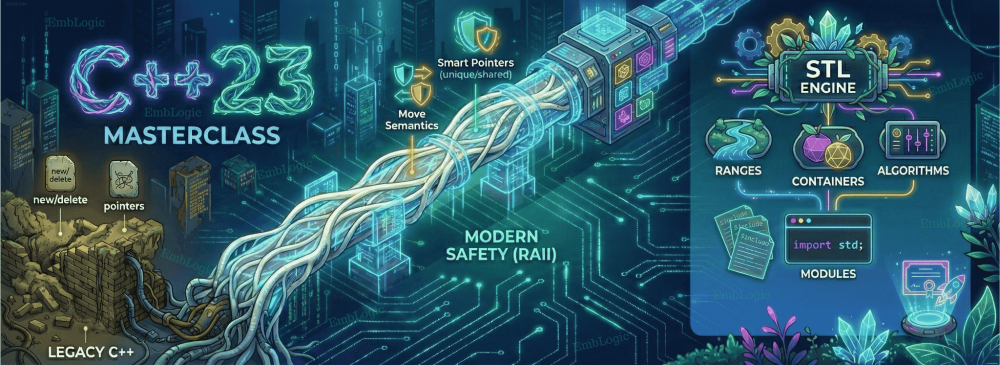
Unlock the full potential of modern C++23 programming and advanced STL with this comprehensive course. Designed for developers ready to move beyond legacy standards, this course begins by configuring a cutting-edge development environment and exploring the latest features in c++23. It then takes the trainee to master memory safety, permanently abandoning manual allocation/deallocation in favor of RAII, Smart Pointers, and efficient Move Semantics. Finally, we dive deep into the Standard Template Library (STL), equipping you with the expertise to leverage advanced containers and algorithms. Join us to start writing cleaner, faster, and safer C++ applications today.
Program Overview
Structured as a progressive technical journey, this program guides learners through the strict standards of C++23. We begin by establishing a professional-grade toolchain and mastering the new compilation model, including modules and modern I/O. The curriculum then pivots to memory architecture, fundamentally changing how you manage resources by replacing legacy new/delete patterns with robust resouces alloction, Move Semantics, and Smart Pointers. Finally, we dissect the Standard Template Library (STL), examining the performance characteristics of every major container category—from vectors to unordered maps. This is a holistic training path designed to transform basic C++ knowledge into production-grade engineering skills.
Objective
The primary objective of this course is to elevate your engineering skills to the C++23 standard, transitioning you from legacy practices to modern, high-performance paradigms. You will aim to master the complete development lifecycle: configuring modern toolchains, enforcing memory safety through RAII and Smart Pointers, and optimizing data handling using the Standard Template Library (STL). Beyond theory, the course emphasizes architectural decision-making regarding container selection and move semantics. Your journey concludes with a comprehensive Final Project, where you will synthesize these concepts to architect a robust, leak-free application using C++23 modules and advanced data structures.
Target Audience
This course is specifically designed for developers looking to bridge the gap between legacy C++ and the modern C++23 standard. It is ideal for:
Legacy C++ Developers Engineers currently working with older standards (C++98/11/14) who need to modernize their skill set. If you are still relying on new, delete, and manual pointers, this course will help you transition to RAII, Smart Pointers, and Move Semantics.Junior Systems Engineers & CS Graduates Individuals with academic knowledge of C++ who want to learn industry-standard practices. This course transforms theoretical knowledge into production-ready skills, focusing on memory safety and the efficient use of the STL.Developers Switching from C, Java, or C# Programmers experienced in other languages who wish to master C++ systems programming. You will learn how to manage memory without a Garbage Collector and how to set up professional environments using GCC, Clang, or MSVC.Performance-Oriented Programmers Game developers, embedded systems engineers, or high-frequency trading (HFT) developers who require the latest C++23 features and toolchains to write highly optimized, zero-overhead code.
Duration
40 Live online session of 1 hour each.at 4 sessions per week, it should take 10 weeks for complete course.
Prerequisites
To get the most out of this course, participants should meet the following requirements:
1. Knowledge & Experience
Basic Programming Proficiency: Familiarity with core programming concepts (variables, loops, functions, and control flow) in C++ or a similar systems language (like C, Rust, or C#).Understanding of Pointers & References: A foundational understanding of how memory addresses and references work is highly recommended, as we will be modernizing these concepts using Smart Pointers and Move Semantics.Object-Oriented Basics: Knowledge of classes, structs, and basic inheritance will help when navigating the Standard Template Library (STL).
2. Technical Requirements
Operating System: A recent version of Windows (10/11), macOS, or a modern Linux distribution.Development Environment: Participants must have a machine capable of installing and running a compiler with C++23 support.Windows: Visual Studio 2022 (v17.6 or later).Linux: GCC 13.0+ (GCC 14 recommended).macOS/Cross-Platform: Clang 16.0+ (Clang 17/18 recommended).
Deliverables
Training Methodology
• Hands on approach to training, behaviorial model of training would be practiced.• During the training, the Trainee whould implement a challenging projects related to concepts absorbed.• Comitment to Individual growth and constant evaluation.• EmbLogicTM would• provide assistance in preparing resume.• issue The Certificate of Completion for the training as mentioned above.
Course Curriculum. click here...
On completion of this Training, the trainee will have following skills. click here...
About C++23. (click here...)
About Advanced STL. (click here...)
Training Resources (click...)
EmbLogic™ is an ISO 9001:2008(QMS) (Quality Management System) Certified Company.
