Course: Linux Device Drivers Development
An Introduction to Linux Device Drivers
Linux device drivers are essential software components that act as a bridge between hardware devices and the operating system. Residing within the Linux kernel, they translate high-level commands, like 'read a file,' into low-level, hardware-specific instructions that the device understands. Writing drivers from scratch is a crucial skill for embedded systems engineers and kernel developers. It allows for the support of new and custom hardware, deep system optimization, and provides an unparalleled understanding of kernel internals. These drivers are typically loaded as modules, allowing for the dynamic extension of the kernel's capabilities without a reboot.
Course Objective
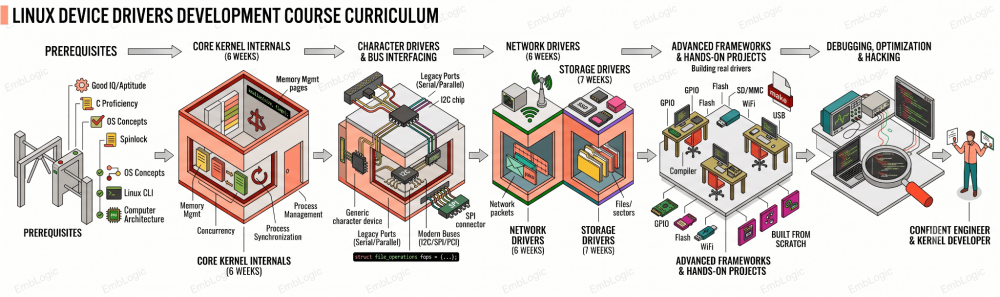
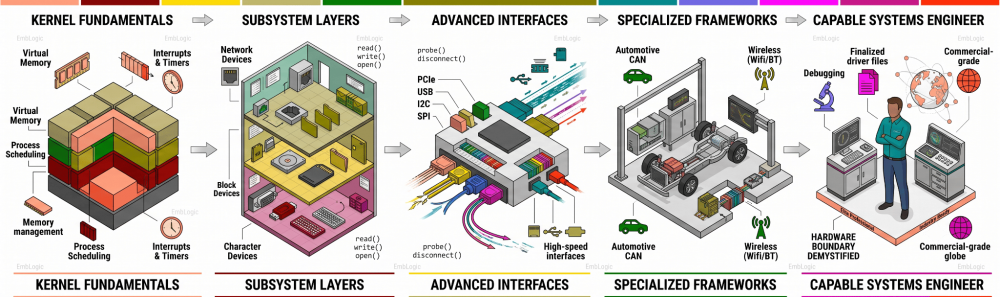
This comprehensive training program is engineered to cultivate elite systems software professionals capable of architecting, developing, and debugging diverse Linux device drivers entirely from scratch. Participants will transition seamlessly from foundational kernel space paradigms to advanced hardware-software co-design methodologies. Over a highly structured, project-driven curriculum, engineers will master core kernel internals, virtual memory management, concurrency, synchronization mechanisms, timers and interrupts. Hands-on development will focus on implementing production-grade drivers across vital subsystems, including Character, Block, and Network layers, as well as modern high-speed interfaces like PCI, USB, I2C, and SPI. Additionally, trainees will acquire deep, industry-ready competencies in deploying specialized automotive and wireless frameworks. By fully demystifying the critical hardware-to-operating-system boundary and emphasizing rigorous kernel debugging, system diagnostics, and hardware testing methodologies, this course empowers aspiring systems engineers to confidently lead complex, commercial-grade driver development initiatives.
Pre Requisite |
click here... |
→The aspirant should have good IQ, aptitude and have stamina to work for long hours.→Strong proficiency in the C programming language.→Good understanding of operating system concepts.→Familiarity with the Linux command line.→Basic knowledge of computer architecture.
Agenda
The Duration of Training would be:
→The duration of training would be 12 months (approx)→There would be 200 Live Online Classroom Sessions of 1 Hours each.→Every Session would be Followed by An Assignment.
Salient Features of the Training Program
→Year-Long Comprehensive Curriculum: A 52-week duration ensures an exhaustive and deep dive into every topic.→Live and Interactive: The program is delivered through live online sessions, allowing for real-time interaction and Q&A.→Build from Scratch: Every device driver is written from the ground up, providing a fundamental understanding of the code.→Project-Driven Learning: The course includes multiple hands-on projects, such as drivers for GPIO, Flash Storage, SD/MMC cards, and WiFi.→Wide Range of Drivers: It covers an extensive list of driver types, including character, block, network, USB, I2C, SPI, and PCI.→Strong Foundational Module: The first six weeks are dedicated to core kernel concepts like memory management, concurrency, and synchronization.→Focus on Modern Frameworks: Includes modern kernel subsystems like SocketCAN for CAN bus and mac80211 for WiFi drivers.→Real-World Hardware Interfacing: Projects involve working with actual hardware like sensors, storage cards, and USB dongles.→Structured and Progressive: The course is logically structured into five parts, taking students from fundamentals to advanced topics.→In-depth Network Driver Module: A dedicated six-week module focuses on Ethernet and WiFi driver development.→Storage Driver Specialization: A comprehensive seven-week module is dedicated to block device drivers for various storage types.→Covers Legacy and Modern Buses: The curriculum includes both legacy ports (Serial, Parallel) and modern high-speed buses (PCI, USB).→Practical Kernel Skills: Students learn essential skills like compiling the kernel, working with modules, and using procfs/sysfs.→Emphasis on Debugging: The course concludes with advanced topics, including kernel debugging and hacking techniques.→Clear Prerequisites: The program clearly outlines the necessary skills in C programming, OS concepts, and Linux CLI for student success.

Course Structure: Linux Device Drivers Development ...
After The Training is over, The trainee should be able to ...
Future Prospects ...
Sessions and Assignments Plan ...
EmbLogic™ is an ISO 9001:2008(QMS) (Quality Management System) Certified Company.