
Linux System Programming with Project. Level 1. (P103)
Introduction
Program Overview
Salient Features of Advanced Linux System Programming
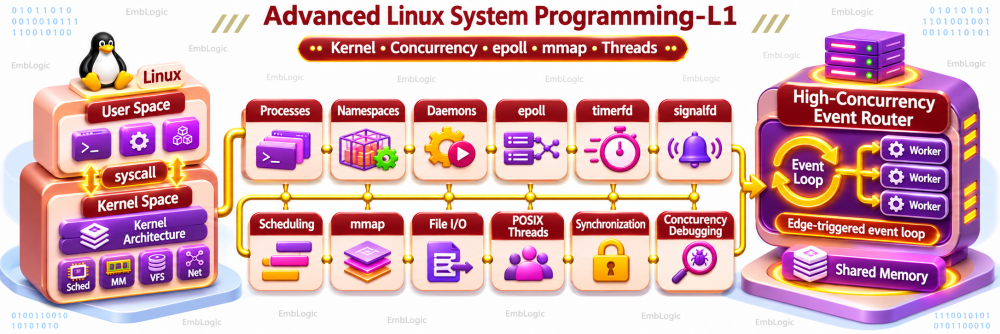
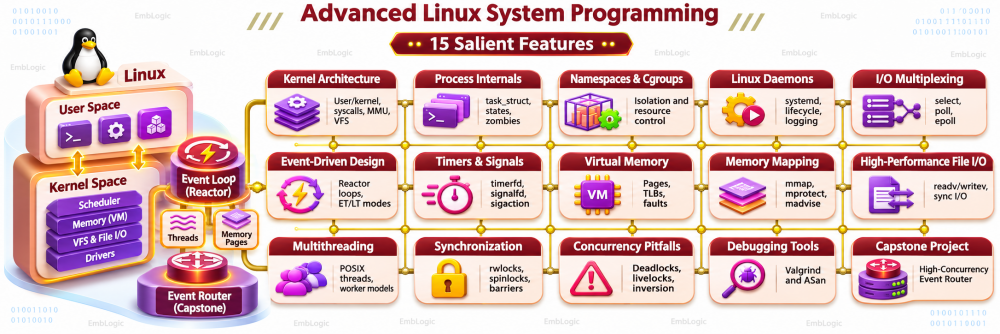
Master Linux Kernel Architecture: Explore user-kernel boundaries, privilege levels, system calls, scheduling, virtual memory, and essential kernel subsystems.Go Beyond Basic Process Programming: Investigate task_struct, process execution contexts, state transitions, zombie processes, and orphan process management.
Explore Linux Containerization Foundations: Understand namespaces and control groups (cgroups), the mechanisms underpinning process isolation and resource management.
Engineer Reliable Linux Daemons: Develop background services and integrate them with systemd for lifecycle management, logging, and controlled execution.
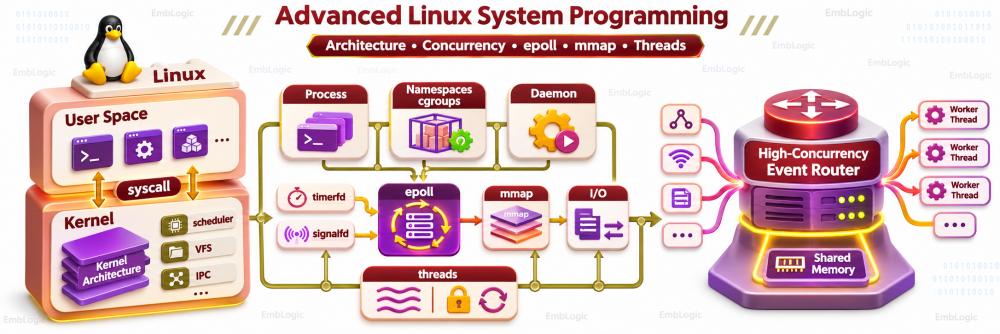
Master High-Performance I/O Multiplexing: Advance beyond select() and poll() to scalable event handling using Linux epoll.
Build Event-Driven Software Architectures: Design reactor-pattern event loops using edge-triggered and level-triggered I/O notifications.
Integrate Advanced Timers and Signal Handling: Combine POSIX clocks, timerfd, signalfd, and sigaction for responsive, reliable applications.
Explore Linux Virtual Memory Internals: Understand page tables, Translation Lookaside Buffers (TLBs), page faults, and virtual memory behavior.
Master Advanced Memory Mapping Techniques: Apply mmap(), munmap(), mprotect(), and madvise() to develop memory-efficient Linux applications.
Optimize High-Performance File Operations: Explore vectored I/O, memory-mapped files, synchronized writes, and techniques for reducing system-call overhead.Develop Advanced Multithreaded Applications: Strengthen POSIX threading expertise through read–write locks, spinlocks, barriers, and thread-local storage.
Conquer Complex Concurrency Challenges: Learn to identify and prevent deadlocks, livelocks, priority inversion, and synchronization bottlenecks.
Debug Memory Errors with Professional Tools: Gain practical exposure to Valgrind and AddressSanitizer for detecting memory corruption and programming defects.
Build a High-Concurrency Event Router: Implement an integrated C programming project featuring epoll, worker thread pools, timers, signal handling, and shared memory-mapped data.
Advance Toward Professional Linux Systems Engineering: Develop the technical foundation to design, troubleshoot, and optimize scalable, concurrent, high-performance Linux user-space applications.
Target Audience
Linux System Programmers seeking expertise in advanced system-level programming.Embedded Linux Engineers aiming to develop efficient, concurrent user-space applications.Systems Software Developers interested in event-driven architectures, memory management, and high-performance I/O.Engineers with 1–2 years of relevant experience seeking to strengthen their Linux internals and concurrency skills.Aspiring Systems Engineers preparing for technically demanding roles in Linux-based software development.
Training Agenda:
→30 Live Online Session of 1 hour each.→3 or 4 Sessions per week on Working Days.→Approximately 10 weeks.
Online: Live interactive sessions with real-time coding and Q&A.
In-person: Classroom sessions focused on hands-on practice and collaborative learning.
Hybrid: Combination of online lectures with in-person or virtual labs for practical application.
Lectures: Detailed presentations on theoretical concepts and coding techniques.
Hands-On Labs: Practical Hands-on exercises and labs to apply learned concepts.
Reading Assignments: Selection of notes, documentation, and articles to supplement learning.
Videos: Access to video tutorials for visual learning of complex topics.
