#include<stdio.h>
int main()
{
int a,b;
printf(“Enter the value of a:”);
scanf(“%d”,&a);
printf(“Enter the value of b:”);
scanf(“%d”,&b);
a=a+b;
b=a-b;
a=a-b;
printf(“%d”,a);
printf(“%d”,b);
return 0;
}


#include<stdio.h>
int main()
{
int a,b;
printf(“Enter the value of a:”);
scanf(“%d”,&a);
printf(“Enter the value of b:”);
scanf(“%d”,&b);
a=a+b;
b=a-b;
a=a-b;
printf(“%d”,a);
printf(“%d”,b);
return 0;
}
#acquire the parallel port by my device driver...
RCS file: header.h,v
Working file: header.h
head: 1.1
branch:
locks: strict
access list:
symbolic names:
keyword substitution: kv
total revisions: 1;	selected revisions: 1
description:
include all the header file need for this project like init, module, fs, cdev, slab and ioport for the parallel port...
define some macros like DEVNAME as device name MAJORNO MINORNO QSET_SIZE QUANTUM_SIZE
define the struct ScullDev and ScullQset....
define the struct of file_operation for the mapping...
----------------------------
revision 1.1
date: 2014/06/23 05:08:09;  author: root;  state: Exp;
Initial revision
=============================================================================

RCS file: init.c,v
Working file: init.c
head: 1.1
branch:
locks: strict
access list:
symbolic names:
keyword substitution: kv
total revisions: 1;	selected revisions: 1
description:
call the module_init and module_exit for initilization and cleanup respectively..
alloc_chrdev_region, cdev_init, check_region,release_region, request_region, and cdev_add
in module_exit function call release_region, unregister_chrdev_region....
----------------------------
revision 1.1
date: 2014/06/23 05:08:09;  author: root;  state: Exp;
Initial revision
=============================================================================
Succesfully implemented the parallel port outb operations using 8-led array!!!
I had firstly make a sculldev allocate memory to it so that i can map the file_operations through the
cdev_init and cdev_add operations and then map the parallel port address to the user address,then map the write operation to the driver and i had made a application for sending the data byte from the application through the node to the driver and received by the scull_write function in the map space then get the data from the application to the __user *buffer and then copy_from_user to get the data from application and then save it in the unsigned char buffer and then outb the data to the parallel port and continuously sending the data from the application and sending the data continuously to the port and the binary representation of the characters are shown on the led’s.
Device Drivers
If you choose to write a device driver, you must take everything written here as a guide, and no more. I cannot guarantee that this chapter will be free of errors, and I cannot guarantee that you will not damage your computer, even if you follow these instructions exactly. It is highly unlikely that you will damage it, but I cannot guarantee against it. There is only one “infallible” direction I can give you: Back up! Back up before you test your new device driver, or you may regret it later.
What is a Device Driver?
What is this “device driver” stuff anyway? Here’s a very short introduction to the concept.
User-space device drivers
It’s not always necessary to write a “real” device driver. Sometimes you just need to know how to write code that runs as a normal user process and still accesses hardware.
Device Driver Basics
Assuming that you need to write a “real” device driver, there are some things that you need to know regardless of what type of driver you are writing. In fact, you may need to learn what type of driver you ought to write…
Character Device Drivers
This section includes details specific to character device drivers, and assumes that you know everything in the previous section.
TTY drivers
This section hasn’t been written yet. TTY drivers are character devices that interface with the kernel’s generic TTY support, and they require more than just a standard character device interface. I’d appreciate it if someone would write up how to attach a character device driver to the generic TTY layer and submit it to me for inclusion in this guide.
Block Device Drivers
This section includes details specific to block device drivers (suprise!)
Writing a SCSI Device Driver
This is a technical paper written by Rik Faith at the University of North Carolina.
Network Device Drivers
Alan Cox gives an introduction to the network layer, including device drivers.
Supporting Functions
Many functions are useful to all sorts of drivers. Here is a summary of quite a few of them.
Translating Addresses in Kernel Space
An edited version of a post of Linus Torvalds to the linux-kernel mailing list about how to correctly deal with translating memory references when writing kernel source code such as device drivers.
Kernel-Level Exception Handling
An edited version of a post of Joerg Pommnitz to the linux-kernel mailing list about how the new exception mechanism works.
intoduction of divice driver:-
One of the many advantages of free operating systems, as typified by Linux, is that their internals are open for all to view. The operating system, once a dark and mysterious area whose code was restricted to a small number of programmers, can now be readily examined, understood, and modified by anybody with the requisite skills. Linux has helped to democratize operating systems. The Linux kernel remains a large and complex body of code, however, and would-be kernel hackers need an entry point where they can approach the code without being overwhelmed by complexity. Often, device drivers provide that gateway.
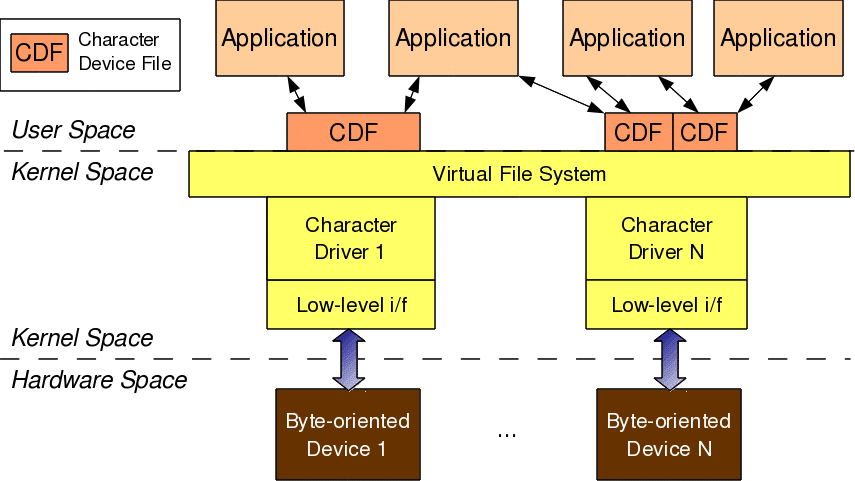
Device drivers take on a special role in the Linux kernel. They are distinct “black boxes” that make a particular piece of hardware respond to a well-defined internal programming interface; they hide completely the details of how the device works. User activities are performed by means of a set of standardized calls that are independent of the specific driver; mapping those calls to device-specific operations that act on real hardware is then the role of the device driver. This programming interface is such that drivers can be built separately from the rest of the kernel and “plugged in” at runtime when needed. This modularity makes Linux drivers easy to write, to the point that there are now hundreds of them available.
There are a number of reasons to be interested in the writing of Linux device drivers. The rate at which new hardware becomes available (and obsolete!) alone guarantees that driver writers will be busy for the foreseeable future. Individuals may need to know about drivers in order to gain access to a particular device that is of interest to them. Hardware vendors, by making a Linux driver available for their products, can add the large and growing Linux user base to their potential markets. And the open source nature of the Linux system means that if the driver writer wishes, the source to a driver can be quickly disseminated to millions of users.
This book teaches you how to write your own drivers and how to hack around in related parts of the kernel. We have taken a device-independent approach; the programming techniques and interfaces are presented, whenever possible, without being tied to any specific device. Each driver is different; as a driver writer, you need to understand your specific device well. But most of the principles and basic techniques are the same for all drivers. This book cannot teach you about your device, but it gives you a handle on the background you need to make your device work.
As you learn to write drivers, you find out a lot about the Linux kernel in general; this may help you understand how your machine works and why things aren’t always as fast as you expect or don’t do quite what you want. We introduce new ideas gradually, starting off with very simple drivers and building on them; every new concept is accompanied by sample code that doesn’t need special hardware to be tested.
This chapter doesn’t actually get into writing code. However, we introduce some background concepts about the Linux kernel that you’ll be glad you know later, when we do launch into programming.
RCS file: cd_basic1.c,v
Working file: cd_basic1.c
head: 1.1
branch:
locks: strict
access list:
symbolic names:
keyword substitution: kv
total revisions: 1; selected revisions: 1
description:
a program of character driver to say kernel to hello
—————————-
revision 1.1
date: 2014/06/21 10:53:33; author: root; state: Exp;
Initial revision
=============================================================================
RCS file: ./soc_th_server.c,v
Working file: ./soc_th_server.c
head: 1.1
branch:
locks: strict
access list:
symbolic names:
keyword substitution: kv
total revisions: 1; selected revisions: 1
description:
cleint program using socket with thread
server program using socket with thread
socket program using socket with thread
—————————-
revision 1.1
date: 2014/06/21 06:32:26; author: root; state: Exp;
Initial revision
=============================================================================
head 1.1;
access;
symbols;
locks
root:1.1; strict;
comment @ * @;
1.1
date 2014.06.21.09.20.59; author root; state Exp;
branches;
next ;
desc
@print on kernel.
@
1.1
log
@Initial revision
@
head 1.1;
access;
symbols;
locks
emblogic:1.1; strict;
comment @ * @;
1.1
date 2014.06.21.06.46.49; author emblogic; state Exp;
branches;
next ;
desc
@create a module..
using module_init and module_exit system calls..
then insert and delete the module from the list of modules..
@
head 1.1;
access;
symbols;
locks
root:1.1; strict;
comment @ * @;
1.1
date 2014.06.20.12.16.30; author root; state Exp;
branches;
next ;
desc
@own driver .
@
1.1
log
@Initial revision
@
text
@#include”header.h”
static int initialization_fun(void)
{
printk(KERN_INFO”hello kernel”);
return 0;
}
static void cleanup_fun(void)
{
printk(KERN_INFO “BYE FOR NOW,I WILL BE BACK”);
}
module_init(initialization_fun);
module_exit(cleanup_fun);
@
As a programmer, you will be able to make your own choices about your driver, choosing an acceptable trade-off between the programming time required and the flexibility of the result. Though it may appear strange to say that a driver is “flexible,” we like this word because it emphasizes that the role of a device driver is providing mechanism, not policy.
The distinction between mechanism and policy is one of the best ideas behind the Unix design. Most programming problems can indeed be split into two parts: “what capabilities are to be provided” (the mechanism) and “how those capabilities can be used” (the policy). If the two issues are addressed by different parts of the program, or even by different programs altogether, the software package is much easier to develop and to adapt to particular needs.
For example, Unix management of the graphic display is split between the X server, which knows the hardware and offers a unified interface to user programs, and the window and session managers, which implement a particular policy without knowing anything about the hardware. People can use the same window manager on different hardware, and different users can run different configurations on the same workstation. Even completely different desktop environments, such as KDE and GNOME, can coexist on the same system. Another example is the layered structure of TCP/IP networking: the operating system offers the socket abstraction, which implements no policy regarding the data to be transferred, while different servers are in charge of the services (and their associated policies). Moreover, a server like ftpd provides the file transfer mechanism, while users can use whatever client they prefer; both command-line and graphic clients exist, and anyone can write a new user interface to transfer files.
Where drivers are concerned, the same separation of mechanism and policy applies. The floppy driver is policy free — its role is only to show the diskette as a continuous array of data blocks. Higher levels of the system provide policies, such as who may access the floppy drive, whether the drive is accessed directly or via a filesystem, and whether users may mount filesystems on the drive. Since different environments usually need to use hardware in different ways, it’s important to be as policy free as possible.
When writing drivers, a programmer should pay particular attention to this fundamental concept: write kernel code to access the hardware, but don’t force particular policies on the user, since different users have different needs. The driver should deal with making the hardware available, leaving all the issues about how to use the hardware to the applications. A driver, then, is flexible if it offers access to the hardware capabilities without adding constraints. Sometimes, however, some policy decisions must be made. For example, a digital I/O driver may only offer byte-wide access to the hardware in order to avoid the extra code needed to handle individual bits.
You can also look at your driver from a different perspective: it is a software layer that lies between the applications and the actual device. This privileged role of the driver allows the driver programmer to choose exactly how the device should appear: different drivers can offer different capabilities, even for the same device. The actual driver design should be a balance between many different considerations. For instance, a single device may be used concurrently by different programs, and the driver programmer has complete freedom to determine how to handle concurrency. You could implement memory mapping on the device independently of its hardware capabilities, or you could provide a user library to help application programmers implement new policies on top of the available primitives, and so forth. One major consideration is the trade-off between the desire to present the user with as many options as possible and the time in which you have to do the writing as well as the need to keep things simple so that errors don’t creep in.
Policy-free drivers have a number of typical characteristics. These include support for both synchronous and asynchronous operation, the ability to be opened multiple times, the ability to exploit the full capabilities of the hardware, and the lack of software layers to “simplify things” or provide policy-related operations. Drivers of this sort not only work better for their end users, but also turn out to be easier to write and maintain as well. Being policy free is actually a common target for software designers.
Many device drivers, indeed, are released together with user programs to help with configuration and access to the target device. Those programs can range from simple utilities to complete graphical applications. Examples include the tunelpprogram, which adjusts how the parallel port printer driver operates, and the graphical cardctl utility that is part of the PCMCIA driver package. Often a client library is provided as well, which provides capabilities that do not need to be implemented as part of the driver itself.
The scope of this book is the kernel, so we’ll try not to deal with policy issues, or with application programs or support libraries. Sometimes we’ll talk about different policies and how to support them, but we won’t go into much detail about programs using the device or the policies they enforce. You should understand, however, that user programs are an integral part of a software package and that even policy-free packages are distributed with configuration files that apply a default behavior to the underlying mechanisms.
RCS file: ./header.h,v
Working file: ./header.h
head: 1.1
branch:
locks: strict
access list:
symbolic names:
keyword substitution: kv
total revisions: 1; selected revisions: 1
description:
include the header files for module_exit()
and for module_init()
also include the license
—————————-
revision 1.1
date: 2014/06/20 11:05:48; author: root; state: Exp;
Initial revision
=============================================================================RCS file: ./init.c,v
Working file: ./init.c
head: 1.1
branch:
locks: strict
access list:
symbolic names:
keyword substitution: kv
total revisions: 1; selected revisions: 1
description:
used module_init() for initialization
used module_exit() for cleanup
—————————-
revision 1.1
date: 2014/06/20 10:58:06; author: root; state: Exp;
Initial revision
=============================================================================