
405.Advanced Character Device Driver Development and Debugging
Abstract
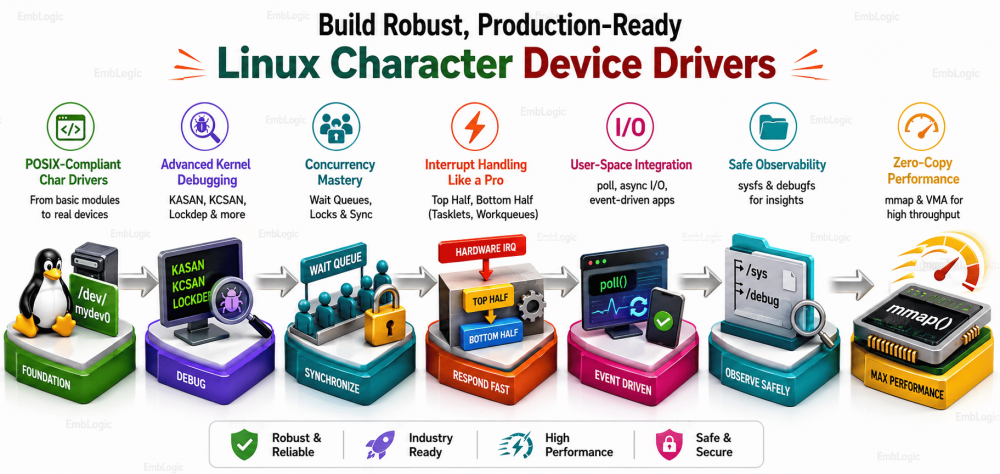
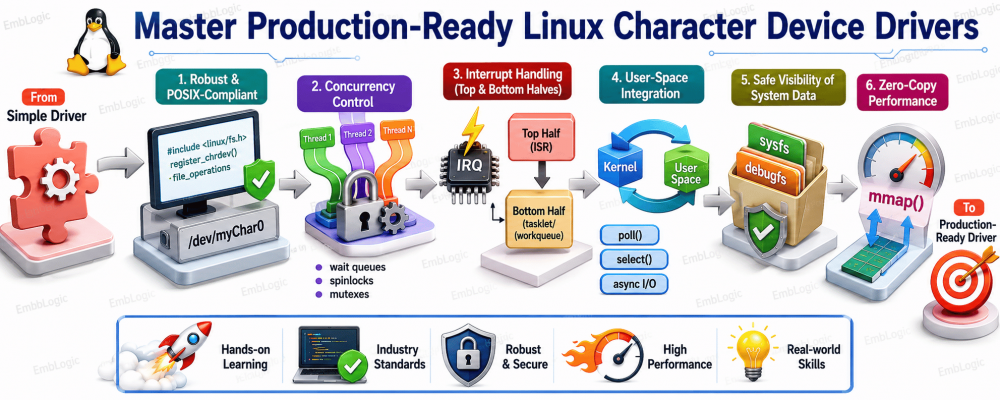
Move beyond basic kernel modules and learn to engineer robust, production-ready Linux character device drivers. This hands-on course bridges the gap between theory and industry standards, transforming simple software drivers into fully POSIX-compliant devices. You will master kernel debugging using advanced sanitizers, manage concurrency with wait queues and locks, and handle unpredictable hardware interrupts using top and bottom halves (tasklets, workqueues).
Through practical, hands-on sessions , you will integrate drivers with modern user-space event loops via poll and asynchronous I/O, safely expose system metrics using sysfs and debugfs, and achieve zero-copy performance by manipulating the virtual memory system with mmap.
Program Overview
"Building Production-Grade Linux Character Drivers" is a technical training course that is geared towards systems engineers who want to take their skills beyond the basic Linux kernel modules. The course covers everything one needs to know about building character devices that meet the requirements of the industry.
The curriculum follows a structured course of critical kernel subsystems. The first task is getting good at kernel debuggers and memory sanitizers so you can solve race conditions and panics on your own. After that, you'll get into developing sophisticated POSIX semantics, using wait queues for concurrency, and hardware interruptions via top and bottom halves.
With rigorous laboratory experiments, you will learn how to incorporate drivers into user-space event loops using poll, how to expose system statistics through sysfs, and how to perform zero copy operations through mmap. Finally, you will become a qualified architect capable of designing and developing device drivers for Linux.
Silent Features of The Program
Duration
• 30 working Days• 30 Live Online Sessions of 1 hour
Training Methodology
• A Linux System would be prepared and training would be done on Newly Prepared Linux system• Hands on approach to training, behaviorial model of training would be practiced.• Comitment to Individual growth and constant evaluation.
Target Audience
• Embedded Linux Engineers tasked with interfacing custom hardware components with the kernel.• Systems Programmers advancing their understanding of low-level concurrency, POSIX semantics, and virtual memory management.• C Developers seeking the specialized architectural skills required to build, debug, and maintain high-performance, mainline-ready kernel modules.
Pre-requisite
• The aspirants must have already finished Linux Character Device Drivers Development. this one(click)...
Course Format
• Live Online Sessions• Hands-on lab sessions• Assignments for every Session• Interview Questions
Program Outline
Deliverables
EmbLogic™ is an ISO 9001:2008(QMS) (Quality Management System) Certified Company.