109: ARM Embedded Linux Board Bring-Up & BSP Development
Embedded Linux, ARM Board Bring-Up & BSP Development
From Source Code to Bootable ARM Hardware... Learn to Be an Embedded Linux Developer!
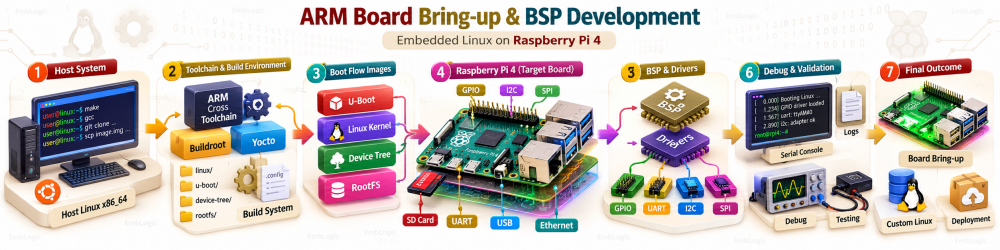
Move past simply executing Linux and learn how to build it for booting on actual ARM boards. EmbLogic’s live online course on Embedded Linux, ARM Board Bring-Up & BSP Development will teach you how to develop Embedded Linux from your own x86_64 development host all the way to a completely bootable Raspberry Pi 4. Learn how to build and configure cross-compilers, learn about the ARM boot process, customize U-Boot, build Linux kernels, create root filesystems, use Device Trees, and debug boot problems via Live Online lab sessions. This program is perfect for developers with knowledge of C programming, Linux systems programming, and device drivers.
Develop it. Boot it. Debug it.
Objective
Turn Your Linux Skills Into ARM-Based Embedded Engineering Expertise
The goal of this program is to equip prospective embedded engineers with the skills needed in ARM Linux platform development that are relevant in the industry. Learners will learn how to integrate hardware and software, understand processor booting, set up boot environments, create their own Board Support Packages (BSPs), and learn how to debug systems. With carefully planned hands-on training conducted by an instructor, participants will learn how to investigate failed boots, fine-tune embedded Linux, and perform independent board bring-up assignments.
Program Overview
From ARM Architecture to a Fully Functional Embedded Linux Platform, Master the Complete Board Bring-Up Journey!
EmbLogic's Embedded Linux, ARM Board Bring-Up & BSP Development program is an intensive, hands-on, live online training initiative designed to transform experienced Linux programmers into competent Embedded Linux and Board Support Package (BSP) engineers.
The program delivers practical experience in developing, configuring, integrating, booting, and troubleshooting an Embedded Linux platform on the ARM Board, powered by the Broadcom BCM2711 ARM Cortex-A72 processor.
Participants progress through the complete embedded platform development workflow, from understanding ARM processor architecture and establishing a cross-development environment to preparing boot components, customizing the Linux kernel, configuring hardware through Device Trees, developing root filesystems, and integrating a functional BSP.
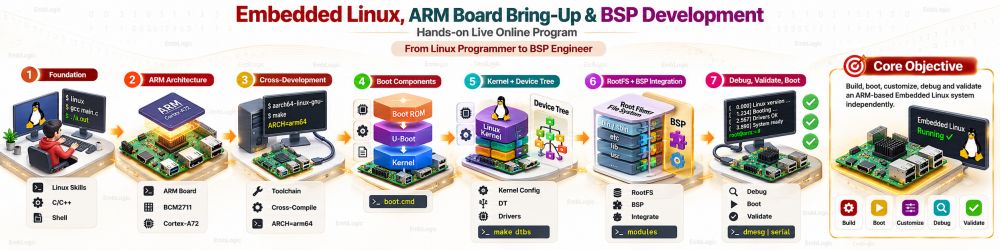
The central objective is to enable participants to independently build, boot, customize, debug, and validate an ARM-based Embedded Linux system.
Program at a Glance
|
Parameter
|
Description
|
|---|---|
|
Training Mode
|
Live Online, Instructor-Led
|
|
Duration
|
30 Sessions, 1 Hour Each
|
|
Program Structure
|
10 Technical Modules
|
|
Host Development Machine
|
x86_64 Linux
|
|
Target Hardware
|
Raspberry Pi 4 Model B
|
|
ARM Processor
|
BCM2711, Quad-Core Cortex-A72
|
|
Target Architecture
|
ARMv8-A, 64-bit (AArch64)
|
|
Target Operating System
|
Linux Kernel 6.x
|
|
Development Languages
|
C, Bash Shell Scripting
|
|
Primary Build Tools
|
GCC, GNU Make, Binutils, Buildroot
|
|
Practical Project
|
ARMBridge — ARM Board Bring-Up & BSP Integration
|
Salient Features of Training program
Embedded Linux, ARM Board Bring-Up & BSP Development
30 Instructor-Led Live Online Sessions: Comprehensive training across 10 structured technical modules, combining conceptual understanding with practical engineering demonstrations.Real Hardware-Based Learning: Gain hands-on experience with the Raspberry Pi 4, powered by the ARM Cortex-A72 processor, using your own development board.End-to-End ARM Board Bring-Up: Understand the complete journey from processor boot initialization to a fully operational Embedded Linux environment.Professional Cross-Development Environment: Configure AArch64 GNU toolchains to compile, link, and deploy ARM64 applications from an x86_64 Linux development host.Linux Kernel Customization & Compilation: Configure, cross-compile, deploy, and validate customized Linux 6.x kernels for ARM-based embedded platforms.Bootloader Development & Integration: Explore Raspberry Pi firmware boot architecture, configure U-Boot, and investigate bootloader operations, kernel loading, and startup failures.Device Tree & Hardware Configuration: Master DTS, DTB, overlays, GPIO descriptions, and hardware configuration techniques essential for Linux BSP development.Root Filesystem Engineering: Develop minimal, customized Embedded Linux root filesystems using BusyBox, startup scripts, and essential Linux utilities.Buildroot-Based BSP Development: Learn to configure Buildroot and integrate toolchains, Linux kernels, root filesystems, and packages into reproducible embedded Linux builds.Kernel Module & Peripheral Integration: Cross-compile and deploy ARM64 kernel modules while exploring GPIO interfaces, device-driver binding, and hardware validation.Serial Console & Boot Troubleshooting: Diagnose bootloader, kernel initialization, Device Tree, and filesystem failures using UART logs and Linux diagnostic tools.Embedded Networking & Remote Development: Configure Ethernet connectivity, establish SSH access, and remotely deploy and test cross-compiled applications.Integrated ARMBridge EmbLogic Project: Build and validate a customized Raspberry Pi 4 Embedded Linux platform through progressive, hands-on engineering assignments.Industry-Oriented Engineering Workflow: Practice source management, configuration control, build reproducibility, deployment procedures, systematic debugging, and BSP validation.Career-Focused Embedded Engineering Competencies: Develop practical skills relevant to Embedded Linux Development, ARM Platform Engineering, Linux BSP Integration, and Board Bring-Up Engineering.
Target Audience
This program is ideal for C/C++ programmers, Linux System Programmers, Linux Device Driver Developers, Embedded Software Engineers, and aspiring BSP Engineers seeking deeper expertise in ARM-based embedded platform engineering.Transform Your Skills Into Real Embedded Engineering CapabilityDon't Just Use Embedded Linux, Learn to Build, Boot, Customize, and Debug It!With EmbLogic's live online training program, you gain practical experience that bridges Linux programming and ARM embedded platform engineering.
Duration
→30 Live Online Session of 1 hour each.→3 Sessions per week on Working Days.→Approximately 10 weeks.
Pre-requisites
Participants are expected to have a working knowledge of Linux, C programming, Bash scripting, basic system programming, and foundational device-driver concepts
Course Delivery
Online: Live interactive sessions with real-time coding and Q&A.
In-person: Classroom sessions focused on hands-on practice and collaborative learning.
Hybrid: Combination of online lectures with in-person or virtual labs for practical application.
Training Methodology
Lectures: Detailed presentations on theoretical concepts and coding techniques.
Hands-On Labs: Practical Hands-on exercises and labs to apply learned concepts.
Reading Assignments: Selection of notes, documentation, and articles to supplement learning.
Videos: Access to video tutorials for visual learning of complex topics.
The Training Program/course. click here...
Practical Training & Development Environment
The program follows an instructor-led, implementation-oriented methodology in which participants independently reproduce demonstrated engineering workflows.
Required Hardware
Raspberry Pi 4 Model B.Suitable microSD card and reliable power supply.USB-to-UART adapter compatible with 3.3 V TTL signaling.Host computer with x86_64 Linux.Network connectivity and suitable peripheral accessories for practical exercises.
Required Software
Ubuntu or equivalent supported Linux development environment.AArch64 GNU cross-compilation toolchain.Linux kernel source and GNU build utilities.U-Boot source and development tools.BusyBox and Buildroot.Serial terminal, Git, GDB, and standard Linux diagnostic tools.
The Project. click here...
Expected Learning Outcomes
On successful completion of the training and practical assignments, participants should be able to:
→Establish and maintain an ARM64 cross-development environment.→Explain and investigate an ARM-based embedded system boot sequence.→Build, configure, and deploy a custom Linux kernel.→Integrate and validate Device Tree configurations.→Develop a minimal embedded Linux root filesystem.→Configure Buildroot to generate deployable BSP images.→Compile, install, and validate ARM64 kernel modules.→Diagnose common boot failures and integration problems.→Prepare reproducible BSP configurations and technical documentation.→Independently execute a complete Raspberry Pi 4 Linux board bring-up workflow.
Deliverables
Upon Completing the Project, EmbLogic would issue Certificate or Letter for the same
Program Boundaries
This program specializes in ARM Embedded Linux board bring-up, platform configuration, and BSP integration.
It provides practical exposure to kernel modules, hardware interfaces, and bootloader customization. Advanced SoC silicon initialization, proprietary firmware development, custom processor architecture ports, production-grade secure boot, comprehensive Yocto development, and advanced peripheral driver implementation are outside the core 30-session scope.
The principal target is Raspberry Pi 4; the engineering methodology and foundational competencies are transferable to other ARM-based embedded platforms, subject to their hardware specifications and vendor BSP requirements.